
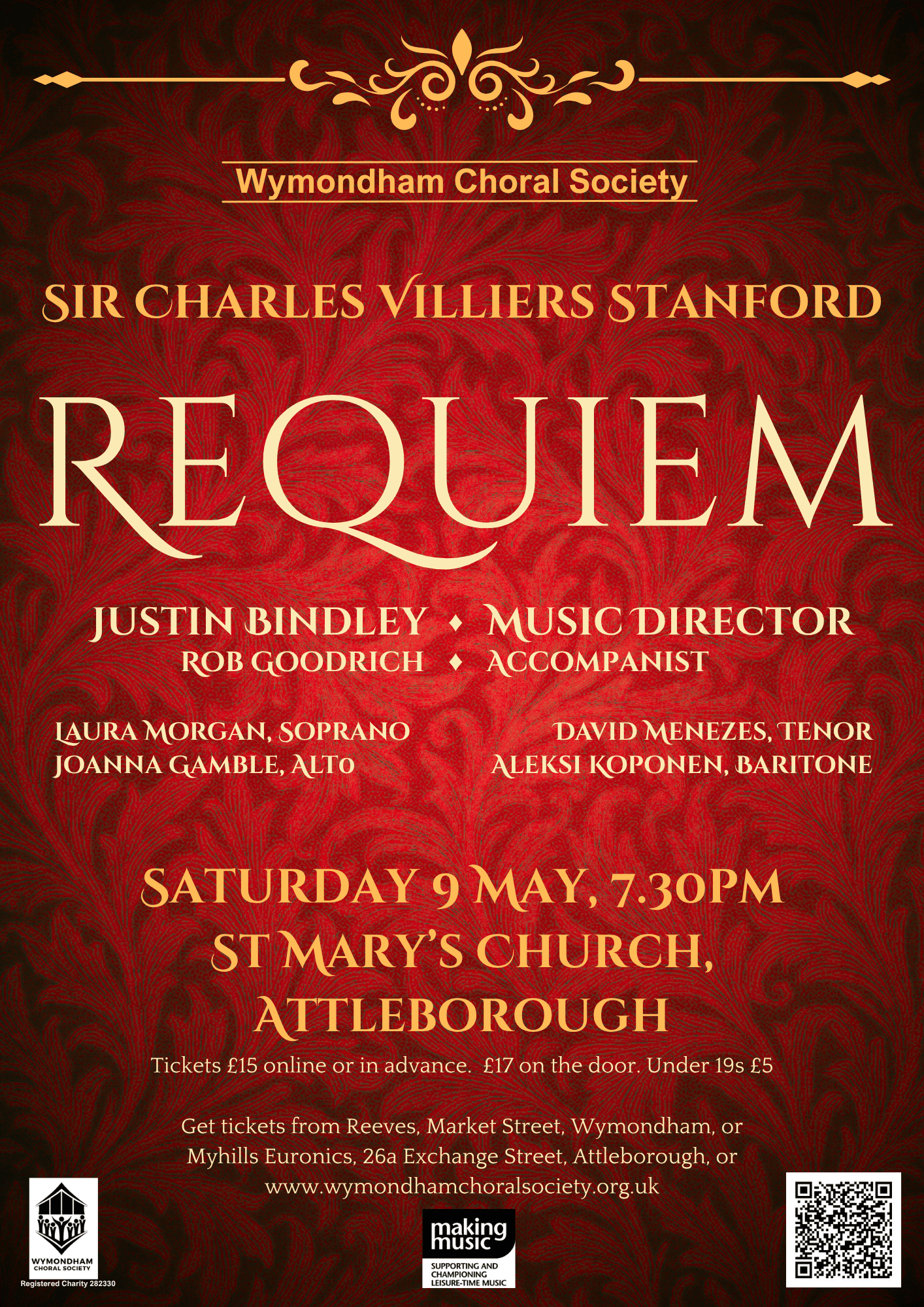
Wymondham Choral Society Presents Stanford Requiem
Wymondham Choral Society are delighted to be performing Requiem by Charles Villiers Stanford. This is a richly textured and deeply moving choral masterpiece, full of soaring melodies and radiant harmonies that promise an uplifting and unforgettable concert experience.
Sir Charles Villiers Stanford (1852–1924), born in Dublin in 1852, established himself in England as a leading figure in the musical life of the country in the late Victorian and Edwardian eras. He was appointed Professor of Composition at the Royal College of Music in London in 1883 and four years later was elected to the Chair of Music at Cambridge. He had a strong influence over generations of composition pupils, although by his final years his once-admired achievements as a composer had fallen out of fashion.
The Requiem, Op. 63, is a large-scale choral masterpiece written in 1896 in memory of Stanford’s friend, the famous Victorian painter, Lord Frederic Leighton, whose death deeply affected him.
Despite being a Protestant composer, Stanford took the unorthodox approach of setting the traditional Roman Catholic liturgy to music, creating a work that balances grand scale with spiritual restraint, looking forward to eternal life even as it contemplates the sorrow of death.
Musically, the work is rooted in the late Romantic tradition and is often compared to the lyrical and consoling nature of Brahms’s Ein Deutsches Requiem, rather than to the more dramatic, fire-and-brimstone approaches of Verdi or Berlioz, whose requiems are more well known to modern audiences.
The work premiered at the Birmingham Triennial Festival in 1897, and although highly regarded at its debut, it fell into neglect for much of the 20th century. Recent recordings have brought the work back into focus, and Wymondham Choral Society is delighted to be able to introduce this beautiful piece of music to its audience at today’s concert.
Stanford’s Requiem follows the standard liturgical movements of the Latin Requiem Mass, and both the Latin text and translation are included below. As with many sacred compositions, sections of the text reappear after their initial introduction, so you may need to refer back through the words and translations as the performance proceeds.